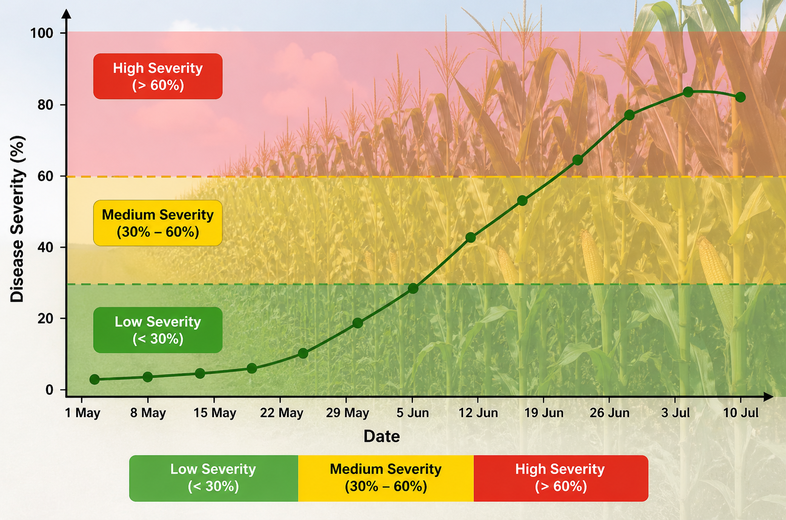
This post shows how to code the Magarey infection model in Python for plant disease forecasting. The workflow turns a generic infection model for foliar fungal pathogens into reusable logic for temperature response, leaf wetness duration, D50 interruption handling, and event-level disease-risk classification.
Paper reference: A Simple Generic Infection Model for Foliar Fungal Plant Pathogens
Magarey Infection Model for Plant Disease Forecasting
For plant diseases, the infection step is the most weather-sensitive part of the epidemic. That is the central framing of Magarey et al (2004) paper, A Simple Generic Infection Model for Foliar Fungal Plant Pathogens. If we can model when temperature and surface wetness are sufficient for infection, we already have the core of a practical disease-warning system for data driven disease management.
Many published infection models are built from dense experimental datasets spanning many combinations of temperature and wetness duration. Those models can work well for a few well-studied pathosystems, but they are difficult to generalize. For many pathogens, especially lesser-studied or exotic ones, that kind of epidemiological dataset does not exist. What may exist instead are cardinal temperatures, a rough wetness requirement, crop compendia, germination studies, or knowledge from related pathogens.
This paper is important because it offers a way to start modeling infection risk from that lighter information base. Rather than fitting a pathogen-specific response surface from scratch, the authors propose a generic infection model built from a small set of biologically interpretable parameters and then validate it across 53 published controlled-environment studies. For a agronomist, that makes the paper less of a single-pathogen case study and more of a blueprint for building an infection-risk engine.
What the Generic Infection Model Actually Does
The paper develops a generic infection submodel for foliar fungal pathogens. Its objective is not to simulate the whole epidemic and not to predict yield loss which this model can be extended too. Its objective is to estimate the wetness duration required to reach a critical infection threshold at a given temperature.
That critical threshold is defined operationally in the paper as:
20% disease incidence, or5% disease severity
on inoculated plant material under nonlimiting inoculum concentration.
That threshold is not meant to represent crop loss directly. The authors use it so infection requirements from many different studies can be compared on the same basis. That is an important distinction when we later translate the model into an operational risk signal.
Why This Generic Infection Model Is a Useful Blueprint
The real contribution of the paper is not just Eq. 1 or Eq. 2 below. It is the overall modeling strategy:
- use a temperature response function with biologically meaningful parameters,
- scale it to a wetness requirement,
- handle dry interruptions for hourly weather workflows,
- test the framework across many pathogens,
- make the model usable even when epidemiological data are incomplete.
That is why the paper is a strong starting point for disease infection-risk modeling. It gives us a compact infection kernel that can be parameterized from literature values or estimates from related organisms, then embedded into a weather-driven pipeline.
What The Authors Used
The core parameters are:
Tmin: minimum temperature for infectionTopt: optimum temperature for infectionTmax: maximum temperature for infectionWmin: minimum wetness duration requirement at the most favorable temperatureWmax: upper boundary on wetness duration requirementD50: critical dry-period interruption value for hourly data
This parameterization is one of the biggest strengths of the paper. Each quantity has biological meaning, which is exactly what we want in a scientist-facing or operational modeling workflow. The model is simple enough to configure, but still anchored in interpretable biology.
Validation Across 53 Studies of Foliar Fungal Pathogens
The authors validated the model against data from 53 published controlled studies, each containing at least four combinations of temperature and wetness duration. That is what turns the paper from an elegant idea into something operationally credible.
The validation reported in the paper is:
- average Pearson correlation coefficient:
r = 0.83 - median Pearson correlation coefficient:
r = 0.94 - root mean square error: about
4.8to4.9 h
The paper also shows substantial variation in pathogen parameters, especially Wmin, which ranged from 1 to 48 h. In practice, that means the code can be generic, but the parameter table cannot be. Parameterization remains pathogen-specific, host-specific, and sometimes tissue-specific.
How To Read The Paper As A Modeling Workflow
If we strip away the prose and tables, the paper becomes a very clean modeling pipeline:
- define a pathogen-specific infection threshold from the literature,
- estimate or collect the pathogen’s cardinal temperatures,
- encode temperature favorability with the Yin response function,
- convert favorability into required wetness duration,
- cap that duration with
Wmax, - handle interrupted wetness using
D50, - compare observed wetness against required wetness,
- flag whether infection conditions were satisfied.
That is the paper-to-program translation.
Step 1: Represent The Pathogen Parameters
The first thing the authors effectively do is reduce each pathosystem into a small parameter set. For example, Table 2 gives the following values for Venturia inaequalis:
params = {
    "Tmin": 1.0,
    "Topt": 20.0,
    "Tmax": 35.0,
    "Wmin": 6.0,
    "Wmax": 40.5,
    "D50": 24.0,
}
In the companion code, these parameters are stored in a plain Python dictionary. In a production workflow, this would become a parameter registry keyed by pathogen, host, tissue, and source study.
The helper functions below use Python’s standard math module:
import math
Step 2: Encode Temperature Favorability With Eq. 2
The mathematical core of the paper is the Yin temperature response function. This function converts mean temperature during a wet period into relative infection favorability.
Outside the valid temperature interval, the response is zero:
$$ f(T) = 0, \text{ if } T < T_{min} \text{ or } T > T_{max} $$
Within the interval, the paper uses:
$$ f(T) = \left(\frac{T_{max} - T}{T_{max} - T_{opt}}\right) \left(\frac{T - T_{min}}{T_{opt} - T_{min}}\right)^{\frac{T_{opt} - T_{min}}{T_{max} - T_{opt}}} $$
In code:
def yin_response(T, Tmin, Topt, Tmax):
    def compute(temp):
        temp = float(temp)
        if temp < Tmin or temp > Tmax:
            return 0.0

        exponent = (Topt - Tmin) / (Tmax - Topt)
        return (
            ((Tmax - temp) / (Tmax - Topt))
            * (((temp - Tmin) / (Topt - Tmin)) ** exponent)
        )

    if isinstance(T, (list, tuple)):
        return [compute(value) for value in T]
    return compute(T)
Step 3: Convert Temperature Favorability Into Required Wetness
Once temperature favorability is known, the wetness requirement is computed with Eq. 1:
$$ W(T) = \min\left(\frac{W_{min}}{f(T)}, W_{max}\right) $$
In other words, favorable temperatures shorten the required wetness duration, while unfavorable temperatures lengthen it. Wmax prevents that requirement from becoming unrealistically large near the temperature limits.
In code:
def wetness_requirement(T, Tmin, Topt, Tmax, Wmin, Wmax=None):
    if Wmax is None:
        Wmax = 3.8 + 3.0 * float(Wmin)

    def compute(temp):
        f_t = yin_response(temp, Tmin, Topt, Tmax)
        if f_t <= 0:
            return math.inf
        return min(float(Wmin) / f_t, float(Wmax))

    if isinstance(T, (list, tuple)):
        return [compute(value) for value in T]
    return compute(T)
The Wmax fallback in that snippet is also from the paper. The authors report a regression relationship:
$$ W_{max} = 3.8 + 3.0 \times W_{min} $$
when observed Wmax is unavailable. That is useful in operational settings where only partial parameter information is known.
Step 4: Handle Leaf Wetness Duration Interruptions With D50
The paper is not only about temperature and minimum wetness. It also addresses a very practical question: what should we do when wetness is interrupted by short dry periods in hourly weather data?
The authors define D50 as the dry-period duration at relative humidities below 95% that causes a 50% reduction in disease compared with a continuous wetness period. Operationally, they use it as the rule for deciding whether two wet periods are additive.
The paper’s logic is:
- if
D < D50, combine the wet periods, - if
D > D50, treat them separately.
In code, the simplest representation is:
def combine_interrupted_wetness(wet1, wet2, dry_hours, D50):
    if float(dry_hours) < float(D50):
        return wet1 + wet2
    return None
Step 5: Convert Hourly Weather Into Leaf Wetness Duration Events
Once we move from paper equations to an actual forecasting workflow, we need to process weather streams into biologically meaningful events.
That means:
- ingest hourly weather,
- determine whether each hour is wet,
- merge wet segments across short dry interruptions when
D50allows it, - compute total wet hours and mean temperature for each event.
In the companion code, this is handled by summarize_wet_periods:
def summarize_wet_periods(rows, d50_hours=None, dry_rh_threshold=95.0):
    ordered = sorted(rows, key=lambda item: item["time"])
    periods = []
    current_wet_rows = []
    pending_dry_rows = []

    def finalize_current_period():
        if not current_wet_rows:
            return
        periods.append(
            {
                "start": current_wet_rows[0]["time"],
                "end": current_wet_rows[-1]["time"],
                "hours_wet": float(len(current_wet_rows)),
                "mean_temp_c": sum(row["temp_c"] for row in current_wet_rows)
                / float(len(current_wet_rows)),
            }
        )

    for row in ordered:
        if row["leaf_wet"]:
            if pending_dry_rows and d50_hours is not None:
                dry_gap_hours = float(len(pending_dry_rows))
                gap_is_dry = all(
                    gap_row.get("rh", 0.0) < dry_rh_threshold
                    for gap_row in pending_dry_rows
                )
                if not (gap_is_dry and dry_gap_hours < float(d50_hours)):
                    finalize_current_period()
                    current_wet_rows = []
            current_wet_rows.append(row)
            pending_dry_rows = []
        elif current_wet_rows:
            pending_dry_rows.append(row)

    finalize_current_period()
    return periods
This is a good example of how a paper concept becomes a software design rule. D50 is not just a parameter we mention. It changes how raw weather data are aggregated before the infection model is evaluated.
Step 6: Compare Observed Wetness Against Required Wetness
Once wet periods are summarized, the model can evaluate each event by comparing observed wetness duration with the paper’s required wetness duration.
In code:
def threshold_progress(observed_wet_hours, required_hours):
    progress = []
    for observed, required in zip(observed_wet_hours, required_hours):
        if not math.isfinite(required) or required <= 0:
            progress.append(0.0)
        else:
            progress.append(float(observed) / float(required))
    return progress


def classify_threshold(progress):
    return [
        "threshold met" if float(value) >= 1.0 else "below threshold"
        for value in progress
    ]
This is the point where the paper becomes an infection-risk workflow. A period with progress >= 1.0 means the environmental conditions satisfied the modeled infection requirement.
That is not the same as field severity, yield loss, or economic threshold. But it is exactly the kind of event-level signal that disease-warning systems need.
Step 7: Package the Python Disease Risk Model
After wet periods and temperatures are available, the rest of the program is straightforward:
def infection_threshold_from_periods(periods, params):
    mean_temps = [period["mean_temp_c"] for period in periods]
    required_hours = wetness_requirement(
        mean_temps,
        params["Tmin"],
        params["Topt"],
        params["Tmax"],
        params["Wmin"],
        params.get("Wmax"),
    )

    observed_hours = [period["hours_wet"] for period in periods]
    progress_values = threshold_progress(observed_hours, required_hours)
    status_values = classify_threshold(progress_values)

    results = []
    for index, period in enumerate(periods):
        result = dict(period)
        result["required_hours"] = required_hours[index]
        result["progress"] = progress_values[index]
        result["status"] = status_values[index]
        result["risk_event"] = progress_values[index] >= 1.0
        results.append(result)
    return results
This can be one of the translation of the paper’s infection logic into a reusable modeling function.
From Paper Model To Operational Disease Management
This is where the paper becomes useful for digital agronomy.
The paper itself gives us an infection submodel. In an operational setting, that submodel can sit inside a broader disease-management pipeline:
- pull hourly observed or forecast weather,
- import leaf wetness from a sensor or estimate it with a validated model,
- build wet periods,
- apply pathogen-specific infection parameters,
- flag infection-threshold events,
- combine those events with crop stage, fungicide protection status, scouting, and inoculum assumptions etc.
That can be one of the operational interpretation. The Magarey model does not replace the full decision-support system. It provides the infection hazard engine inside it.
For example, in a disease management workflow, a threshold met event could be used to:
- trigger a scouting alert,
- raise the infection-risk layer on a map,
- mark a biologically relevant weather event,
- support fungicide timing logic,
- prioritize surveillance for emerging or exotic pathogens.
This use case is also consistent with the paper itself, which notes that the model was being used to create risk maps for exotic pests.
Related Posts for Building a Disease Forecasting Workflow
If you are building a broader weather-driven plant disease forecasting pipeline, these companion posts connect naturally with this Python disease risk model:
- Leaf Wetness Duration (LWD) estimation using CART method for estimating one of the most important inputs to the generic infection model.
- Weather based predictors for predictive modeling for generating weather features used in plant disease forecasting workflows.
- Area Under Disease Gradient (AUDG) Calculation for connecting infection-risk thinking with downstream epidemic analysis.
Takeaway
Magarey et al. is a good paper about how to build a generic infection-risk model when full epidemiological response surfaces are unavailable.
Its logic is simple but powerful:
- characterize the pathogen with cardinal temperatures and wetness parameters,
- compute temperature favorability,
- translate favorability into required wetness duration,
- handle interrupted wetness for hourly weather streams,
- compare observed wetness with required wetness,
- use threshold exceedance as an infection-risk signal in operational disease management.
That is exactly why it remains useful for scientists and digital agronomy teams. It is not just a paper to read. It is a paper you can parameterize, code, test, and deploy as the infection component of a real-time disease-warning system.